
[xrr rating=4/5]
The Itzbeen Baby Care Timer is the first multi-purpose nursery tool designed to help new parents remember the basic details of baby-care. The Itzbeen has four timers that count up with the touch of a button. No more charts and journals. The Itzbeen also allows you to set an optional reminder alarm for each of the timers, for example: change the diaper every 2 hours, or give medication every 4 hours. If the time limit is reached, the appropriate button will light up, and an optional alarm will briefly beep. The Itzbeen has several other helpful features: Nursing Reminder Switch – easily reminds mom which side baby nursed from last, Soft-glow Nightlight – to help parents find their way in the dark without waking the baby (the nightlight automatically goes off after 7 minutes), Backlit Display – so parents can read the times and the clock in the dark, and a Back Clip – makes the Itzbeen Baby Care Timer totally portable and allows for hands-free use of the Nightlight.
- Clean design and simple timer concept.
- Great way to help maintain sanity for new parents during those crazy first few weeks after birth.
- Helps manage your baby’s schedule when getting help from grandparents, babysitters, and child care providers.
- Built in flashlight.
- Super portable, with a handy clip that allows you to attach it to a pocket, belt, diaper bag strap, car seat, etc.
- Limited functionality. If you require more detailed tracking of diaper changes and feedings, you may want to consider trying some of the mobile apps that are available on the Apple or Android app stores.
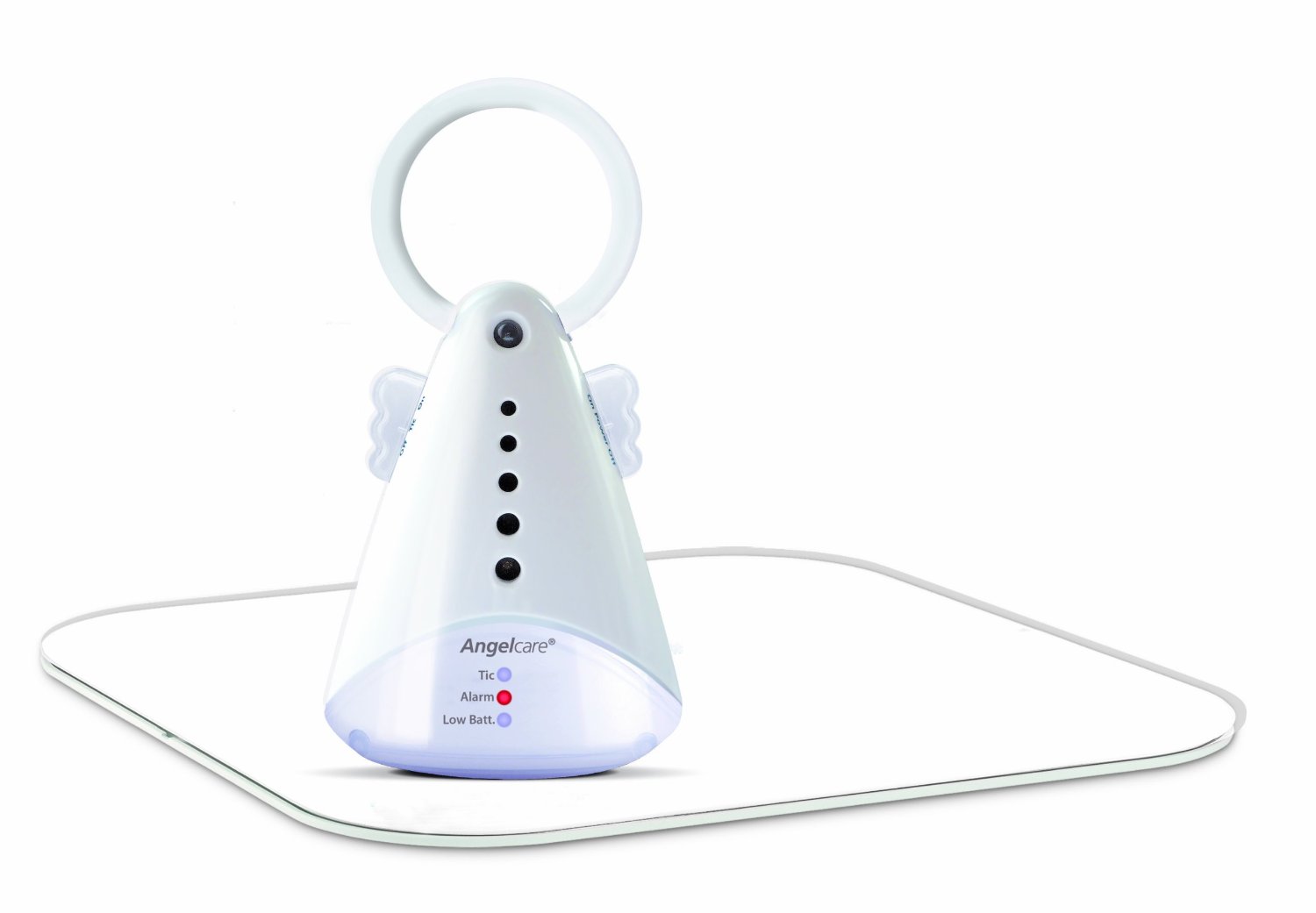
 (AC300) is portable and can be used anywhere baby sleeps. The under-the-mattress sensor pad detects the slightest baby movements and alerts you if no movement is detected for 20 seconds. It is a great addition to the Movement Sensor with Sound Monitor from Angelcare if you have twins sleeping in different beds, in the same room. Can also be a great addition to the Angelcare sound monitor or any other sound monitor for that little extra reassurance. uses a sensor alarm which works in such a way that if movement is not detected after 20 seconds then an alarm will sound to alert you to the situation.
- Easy to set up and use.
- Uses batteries, so no need to find an outlet, and one less cord to secure.
- Portable and easy to use in a variety of situations, from bassinet to crib to pack-n-play.
- Works very well for swaddled and/or wrapped newborns and infants that aren’t moving around too much.
- Manual switch requires you to remember to turn it on and off each time you pick up your baby.
- Once baby starts to roll on their side, or moving to edges of crib, the sensitivity may not pick up their breathing properly, resulting in false alarms.
has really helped my wife and I sleep a little better at night. It provides an extra layer of monitoring that gives us a little extra piece of mind and comfort. It can be a little temperamental when getting it all set up, due to its sensitivity, and once a baby starts sleeping on their side, it may have trouble picking up their breathing, but all in all, we are very happy with its performance. If you already have a video/audio monitor, the basic model works just fine, as you can easily hear the alarm in your nursery through a regular video/audio monitoring system. Otherwise, they have integrated systems that may save you some money and keep your total number of gadgets down a bit. is definitely a worthy addition to your baby nursery, starting with the baby’s first day at home. It helped us sleep better at night, and we think you will too.
Prior to the birth of our first daughter, one of the things my wife and I decided to explore was cord blood banking. When having a child, especially your first, the whole experience can be pretty overwhelming. Most expecting parents are trying to figure out which baby gear to add to their baby registry, which names to add to their shortlist, how to decorate the nursery, and more importantly…how to afford everything. This was certainly the case for us, but after some careful research and multiple discussions between ourselves and with our obstetrician, we decided that it was something that we wanted to do for our family, and we selected Cord Blood Registry. Hopefully, this overview will help other expecting parents decide whether or not cord blood banking is right for you and your family.
What is Cord Blood Banking?
Cord blood banking allows families to store stem cells that are harvested from cord blood extracted from the placental end of a newborn baby’s umbilical cord. The cord blood is usually collected within 10 minutes of giving birth, and then sent to a cord blood storage facility where it is processed and placed into freezers. It is stored there indefinitely in a subzero cryogenic system that preserves the stem cells until a later time when they might be needed to treat medical conditions of the child from whom they originated, or possibly another family member. Hopefully, your child and family will remain healthy, and the stem cells will never be needed. However, many find it comforting to know that they are available should the potential need ever arise.
According to WedMD, cord blood stem cells are considered the building blocks of life. They have the ability to divide and differentiate into diverse specialized cell types, consistent with cells of various tissues such as muscles or nerves. Stem cells have been used for more than 20 years to treat more than 80 life-threatening diseases and disorders, including the treatment of leukemia, lymphoma, and anemia, along with a variety of other hematopoietic, immune system, and genetic disorders, and stem cells are considered a better alternative to bone marrow transplants. Additional treatments and uses are currently being developed all around the world, including the treatment of traumatic brain injury, spinal cord injury, cerebral palsy, Type 1 juvenile diabetes, and autism. While somewhat controversial, and with research and discoveries that are still fairly early-stage, many view this as a sort of insurance policy for their children and family.
Sample Collection Process
Let’s take a step back and talk a little bit about the setup and collection process. For us, the entire process was pretty seamless. After speaking with a company representative on the phone to answer a few questions, we completed the registration process online. They promptly sent us the collection kit in the mail, which provided detailed instructions for our upcoming birth day. We informed our obstetrician that we were collecting the cord blood, and provided the kit to the medical team upon our arrival and admittance to the maternity unit. After the birth of our child and the subsequent cord blood collection, the sealed sample was placed on our newborn daughter’s transport cart and brought with her back to our room. Shortly thereafter, we then called to schedule the sample pickup using a toll-free number provided by the cord blood banking company, and a courier came directly to our room within an hour or two to pickup the sample for preparation and shipment to the main storage facility. After it arrived at the storage facility, the sample went through final preparation steps and was banked in their freezer storage system.
Sample Options
One thing we discovered with our second child is that new technology now allows for additional options on the types of tissue and cells that you can choose to collect and store. For our first daughter, born in March 2010, I believe the only option was cord blood collection and storage. For our second daughter, born in October 2012, the same cord blood banking company now offers the option to also collect and store the cord blood tissue, in addition to or instead of just the cord blood. Of course, there are additional fees for both the upfront cost of collection and the ongoing annual storage cost. We decided to go with the same program as our first daughter, and opted to stick with just the cord blood collection.
Program Costs
Even if parents are interested in cord blood banking, the cost may force many parents to forego this option. To be completely honest, the cost of cord blood banking is rather high. Most cord blood banks have an up front collection and storage preparation fee that ranges from $1,500 to $2,200, and then charge an annual storage fee of $125 to $150. Additional charges apply if you choose to also preserve the cord tissue, in addition to the cord blood.
There is no doubt that this is a steep cost at an expensive time in the lives of young families. So if it comes down to choosing between diapers and formula, or cord blood banking, this decision is an easy choice. In order to help parents manage these upfront costs, most cord blood banks offer payment plans and gift registries that allow family and friends to contribute towards these services. Additionally, a variety of discounts may be available through your obstetrician office, referral programs such as the one offered here for friends of A Modern Dad, and some employers. In our case, my wife is a nurse, and we discovered that we were eligible for a pretty significant discount offered to medical workers by the cord blood bank that we selected. Discounts are also often available for public service providers (military/police/fire/EMT), active students, multiple birth situations, and repeat customers. These discounts greatly helped us to move forward in getting things all set up, so please keep this in mind and be sure to ask.
Banking Options
A variety of cord blood banking options exist across the United States. I suggest checking out the details of at least two or three companies so you can compare options and pricing, and get an overall feel. There are two types of cord blood banks available to expecting parents. The focus of this article is private cord blood banks, which store cord blood for personal use by your family. In various cities across the U.S., and countries around the world, public cord blood banks may also be available. With public banks, cord blood is donated for research or for use by anyone who may need it. In most cases, there is no charge for that service. Unfortunately, samples submitted to public banks are anonymous, and if a family member later requires a stem cell transplant for treatment, your donation is not retrievable.
- Private banking options include Cord Blood Registry (Cbr), Via Cord, Cryo-Cell, and Family Cord. Most private banking options are available throughout the U.S., as long as your obstetrician and delivering hospital are able to provide support.
- Public banking options tend to be more location specific, with centers available in many of the major cities across the country. Options include LifeCord, ClinImmune, National Cord Blood Program, ITxM, and Cord for Life. And you can find a complete list on the National Marrow Donor Program site.
Additionally, some public banks offer sibling-directed donation programs for families that have an older child who has cancer, a life-threatening inherited blood or immune system disorder, sickle cell anemia or thalassemia. These programs will collect and store umbilical cord blood for a biological sibling at no charge to eligible families, and then if/when a stored cord blood unit is used for transplant, a fee is charged to the patient’s insurance company. More information can be found on the National Marrow Donor Program website.
More Information
For additional information, here are a few other sites that provide good information on cord blood banks, and the cord blood industry as a whole: American Association of Blood Banks, Parent’s Guide to Cord Blood Foundation, National Marrow Donor Program, WebMD, and Wikipedia.
Image Credit: thesilhouettestudioblog.com
]]>
With the arrival of A Modern Dad 2.0, we will refocus on newborn issues, while continuing to talk about the trials and tribulations of also raising a toddler. As such, one of the primary anxieties for new parents in the first few days after a newborn arrives is feeding. Is the baby latching on properly? Is she getting enough? When will the mother’s milk come in? Is he hungry? Is she full? These questions are all common concerns, often with no clear and immediate answer. In most cases, this all works itself out within a week or so, and everyone moves on to the next most pressing matter of the day or week.
We would like to talk a little bit about how to manage a very important aspect of feeding in the days and weeks after the milk and/or formula really start flowing…the burp. As a baby gains strength and starts to consume more milk, they tend to take more and more air into their little stomachs. For many babies, air and gas is the root of most evil. This usually leads to fussiness and discomfort, and it often leads to inconsistent sleep patterns as the air and gas cause intermittent pain as it tries to work its way through their little systems. In order to keep your baby comfortable, and keep you and your spouse sane, figuring out how to burp your little one is critical. Here are a few suggestions to hopefully help things go a little more smoothly.
Timing
In most cases, you will want to burp as much as possible, often during feeding at the halfway point, and always after you are done. Obviously, you need to use your own judgment here, but it is usually wise to clear the air from your baby’s tummy when you switch breasts or after every 2 to 3 ounces from a bottle. This will create more room to ensure you little one gets enough nourishment, and it will also help to reduce the likelihood that they will spit up and lose all their hard work. Once the feeding is finished, you will again want to clear as much of the remaining air as possible so it doesn’t cause additional gas problems later.
Positioning
How you position your child for burping will vary from baby to baby and parent to parent, but there are a few tried and tested positions to keep in mind. The first, and probably most common and convenient, is the standard over the shoulder. The allows you easy access to pat your baby’s back, and it keeps them upright with a little pressure on their stomach so the air can work its way up and out, without bringing a lot of milk with it. The second is placing your baby in a sitting position and sideways on your own lap. When a baby is still really small, it can be a bit tricky to properly support their head and body with only one hand (while patting their back with the other), but this has always worked well for me, as the baby’s semi-slumped position tends to bring the air out of their stomach a little more effectively. A third position that you might want to try is laying your baby face down on your lap, with their head resting on one leg and their stomach over the other leg. Support the baby with one hand, while patting their back with other.
Techniques
In addition to the three positions that are commonly used, I often work in a few other techniques that seem to help. For our first daughter, and now our second as well, I have found that while holding them upright on my shoulder, if I lean to my right (the babies left), that often helps release a burp. I also lean the baby (and my torso) forward and back and to the left and right, while bouncing slightly with my knees. This all seems to help work the bubbles to the proper area of the stomach where they can be released up the esophagus. And that, my friends, is how an engineer over thinks the common baby burp.
Back Pats
While burping your baby, it is common to pat their back to help break up air bubbles in their stomachs. It usually doesn’t take much force, so please be gentle with your fragile newborn, and just take your time. Burps have never harmed a baby, and all burps clear themselves eventually. Rubbing the back of a newborn, in addition to or instead of patting, may also be effective for some.
Always Use Protection!
For most of the first twelve months or so, you will want to always have a burp cloth handy. With a backup always nearby as well. Any time you decide to perch a newborn on your shoulder or lap, you are asking for trouble. If you are covered with a burp cloth or a lightweight blanket, you should be able to avoid most major messes. This is especially important when away from your home or traveling. There is nothing worse than having to travel all day with the smell of baby spit up wafting from your shoulder (hyperlink). Trust me.
Queues
Occasionally, you may need to revisit the burping process in between feedings, if your baby becomes fussy. A key queue to listen for is a grunting sound that sounds like your baby is trying to force out some air…because that is probably what they are trying to do. They might also be trying to force something out the other end, or both, but if they recent had a diaper change, then chances are they just need a little help with another burp.
Prevention
For the most part, burping and gas and spit up are just past of the program. There is nothing unusual about it, and as a baby grows and gets stronger, it usually becomes less and less of an issue. However, in some of the more extreme cases of gassiness and spitting up, it might be a sign of other issues like lactose intolerance or food allergies. If you are worried about this, or if it runs in your family, it is probably worth discussing with your pediatrician. Over-the-counter medications such as Mylicon or gripe water might be worth a try. Another issue might be equipment malfunction. Be sure that you are using the proper bottle nipple for the age of your child, and reasonable quantities of milk or formula, so to avoid the intake of excess air.
Sleeping Position
If your baby is really gassy and burpy, sometimes it helps to slightly elevate the head end of their bassinet or crib. This won’t always be possible to do safely, but if so, it might help keep your little one a little more comfortable through a nap or through the night.
 Even after spending most of my adult life living in larger cities, working for a large multinational company, and traveling the world, one of the life experiences that best defines me and who I am as a person is having grown up in Small Town America. And by small, I mean small. As in an official population of 226 people. My graduating class at the local public school was made up of a whopping 38 people!
I grew up in rural Northwest Ohio, in one of the many small farming communities that dot the countryside. Most families there, including mine on both my paternal and maternal sides, have German roots and are members of the local Catholic church. I went to the same elementary and high school as my parents (and had some of the same teachers), my grandparents, my great-grandparents, and probably further back than that, considering my family tree in that area dates back to the mid-1800’s. My grandfather was the mayor of our village in the 1960’s (yes, the town is actually incorporated) and my father was the fire chief for the volunteer fire department for a number of years. It was pure Mayberry.
As is the case with many small towns, my hometown is built firmly on the foundation of a family-first, work hard, take-care-of-your-neighbor type of mentality. A place where everyone knows everyone and family roots run deep, with many families now in their seven or eight generation. A place where kids play in the park until dark almost every summer day. A place where, if something needed repair, you just fixed it yourself, or you called a friend that could help. Unfortunately, fewer and fewer adults from Generation X, Generation Y, and the Millennials are staying in these small towns, and fewer still are returning after leaving for college.
Even though I know that I will probably never live there again, I still occasionally find myself reminiscing about my childhood and hoping to find a special place like that to raise my own children. I can’t imagine myself growing up anywhere else. I am sure there are lots of similar towns across our beautiful country, but I have not found one that has quite the same unique mix of small size, friendly naivety, old-school blue-collar work ethic, and deep family traditions. The bar for my expectations of how and where my children grow up has been set pretty high.
Our daughter recently turned two, and the quality of schools and safety of neighborhoods is quickly becoming a hot topic for my wife and I. That is one of the big reasons that we chose to move on from Phoenix last year and settle our family in Denver. It was very difficult to leave behind so many wonderful friends, but we just felt like Colorado was a better fit for us and our family. Our hope is that we will be able to bring up our daughter in a town or neighborhood that leaves a similar impression on her when she is an adult.
Do you think Mayberry types of towns and neighborhoods still exist? Or has society changed so much that this type of childhood nirvana is just a pipe dream? Do you have fond memories of your childhood neighborhood? Would you want your kids to grow up in your childhood neighborhood? If not, why?
]]>


[xrr rating=5/5]
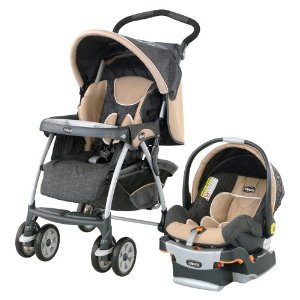
- Well built and sturdy, and has been very reliable for us for over 17 months thus far.
- Easily collapses with just one free hand, assuming you will be holding your baby with the other.
- Car seat snaps securely into the stroller and can be easily removed with just hand, while holding and lifting the seat with the other.
- Removable, washable cloth cover on both car seat and stroller.
- Removable, dishwasher-safe drink/food tray.
The Bad
- The Cortina is only rated to 22lbs. Most babies/toddlers reach this weight by 12 to 18 months. At that point, you will need to purchase a larger car seat. You may want to consider purchasing the Travel System that is rated to 30 pounds instead, in order to get a little more life out of this Chicco system.
- As our daughter got older, and wanted to check out everything going on around her while we were out and about, we realized that we wished the seat adjustment sat up a little bit more. Our daughter has to hold on to the food/drink tray in order to sit straight up.

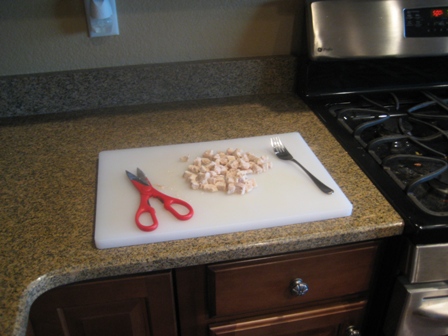
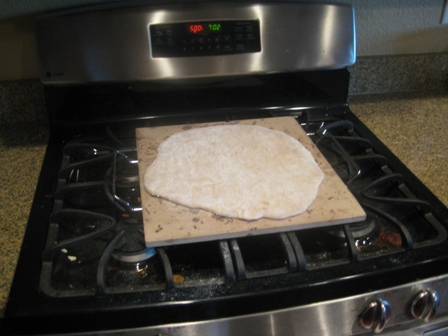
How many of you love pizza? …or at least have kids that do? Okay, how many of you have a pizza stone? If you are like most of us, it is probably stashed somewhere in the depths of your kitchen cupboards, unopened and untouched since you received it as a wedding gift…oh, about six or eight years ago. With Papa John’s on speed dial, or a local favorite pizza joint right down the road, making your own pizza just seems like too much work, right? I am here to say absolutely not.
I am going to show you how to make perfect gourmet pizzas in the comfort of your own kitchen in just minutes. It is a fun family activity. It gives you better control over the quality of ingredients used. And the pizzas taste great! Are you up for the challenge? Okay…here we go.
| Equipment | |
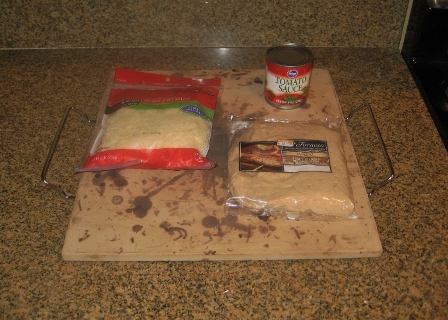 |
|
Ingredients |
Toppings Ideas |
|
|
Preparation |
|
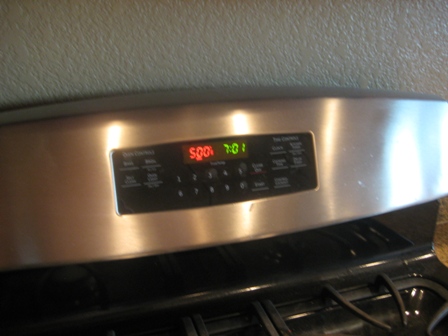 |
|
 |
|
 |
|
 |
|
 |
|
 |
|
 |
|
If you have any questions, or other suggestions for making the perfect pizza at home in your own kitchen, please join the conversation in the comments below, or in the comments over on our Facebook page.
]]> As we discussed in Part 1 of this series, we introduced rice cereal to our baby daughter at six months. Within a week, she started to get sick whenever she ingested it. After initially thinking her illness was caused by some spoiled milk, a dirty bottle, or possibly a virus, we pretty quickly identified the rice cereal as the apparent root cause.
Upon our return to Phoenix from our Santa Fe vacation, we once again consulted with our primary pediatrician. Her feedback was that rice is typically considered the most neutral, hypoallergenic cereal available for babies…especially since it is gluten-free. However, since rice cereal seemed to be the culprit, she advised us to give oat cereal a try instead to see if our daughter would do better with that. We tried that the next day, and again experienced the same excruciating result. Our daughter gobbled up the oat cereal paste, and then about three hours later proceeded to vomit for about three hours. At that point, we knew for sure that something definitely was not right.
We consulted again with our pediatrician. Her latest advice was to just avoid grains all together for a while. Both my wife and I quickly agreed, having already arrived at this obvious conclusion prior to our visit. However, now we were even more perplexed and curious as to what was going on inside our beautiful daughter. Was this “condition” she was experiencing something temporary? Was it being caused by something more serious? Was this something she (we) was going to have to deal with for the rest of her life? These were all questions that were hanging out there, and we needed some answers. Now what?
After some further discussion with our pediatrician, and even though rice cereal is gluten-free, we agreed to do a blood test for celiac disease. According to Mayo Clinic, celiac disease is a digestive condition triggered by consumption of the protein gluten, which is primarily found in bread, pasta, cookies, pizza crust and many other foods containing wheat, barley or rye. People with celiac disease who eat foods containing gluten experience an immune reaction in their small intestines, causing damage to the inner surface of the small intestine and an inability to absorb certain nutrients. Unfortunately, there is no cure for celiac disease and people with the disease are forced to manage their lifestyle and dietary consumption throughout their lifetime. Fortunately, celiac disease and other gluten-related digestive conditions have led to the fairly wide availability of a variety of gluten-free lines of food products and ingredients.
After waiting for about a week or so, our pediatrician informed us that the test for celiac disease had come back negative. This did not completely rule that out, due to our daughter’s young age, but it did reduce the likelihood that celiac was the culprit. Okay…now what? Once again, we consulted with our pediatrician to discuss other possible causes or conditions. Food allergies were considered to be the other most likely cause of our daughter’s grain issues. Childhood allergies have received much press in recent years, as studies have shown possible connections between food allergies and a pretty wide range of common childhood illness, from ear infections to general irritability and colic to ADHD. In many cases, children outgrow these allergies by 3 to 5 years of age, and the best way to deal with them is to just avoid the foods causing the problems. Rather than go through a full battery of allergy tests at such a young age (~8 mths old), we decided to just avoid grains for a while and focus on introducing other foods that would satisfy her nutritional needs for the foreseeable future. This would certainly pose some challenges when mealtime rolled around each day…and especially when it came to snacks (no Cheerios, crackers, bread, cookies, cake, etc.)…but it was certainly something we felt we could manage…for now.
Fast forward eight months. Our daughter is now almost 16 months old and we have learned to manage her dietary restrictions quite well by closely monitoring product ingredients and watching carefully for crumbs on our floors. A few weeks ago, we decided to investigate some more to try to find other possible causes of the grain intolerance/allergy/reaction with which we are dealing. After going in a few different directions with our research, we stumbled onto something called FPIES. FPIES is short for Food Protein-Induced Enterocolitis Syndrome. FPIES is a severe, cell-mediated gastrointestinal food hypersensitivity typically provoked by cow’s milk, soy, grains, poultry, and/or some vegetables. It is commonly characterized by profuse vomiting and diarrhea. As I read through descriptions of the condition and read through details of how FPIES has affected other young children and babies, I started to get goosebumps as I realized that we had finally found some of the answers we were looking for. We visited an allergy clinic this week and confirmed our FPIES suspicions with the doctor, who was familiar with the condition and was in agreement with our discovery.
Check back soon for more details on FPIES, and also for more information on the foods and snacks that have helped us to manage our daughter’s dietary restrictions and keep her healthy.
If you have any questions about how we are dealing with FPIES, please let us know…and please join in the conversation on our website, on Twitter, and on Facebook to share your stories of dealing with childhood food restrictions.
